The Washed Square
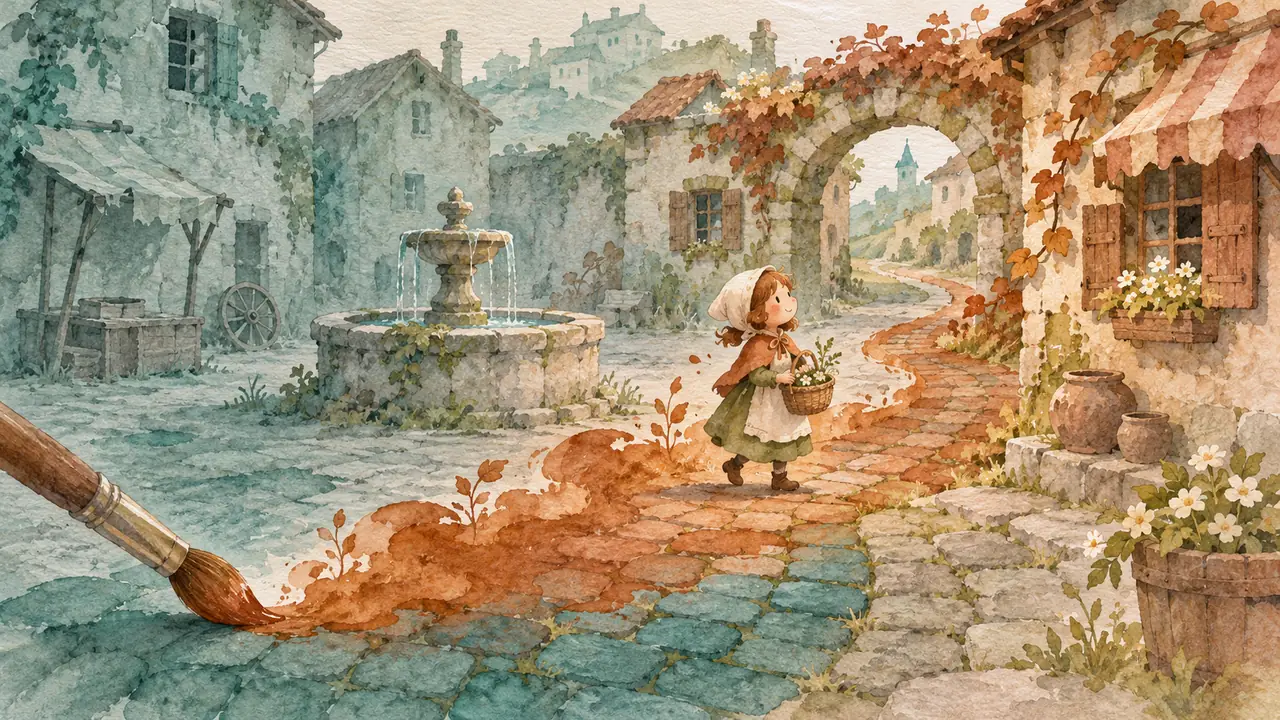
At the beginning of The Washed Square, the edge of an old shop can be read clearly while the rest of the street has faded. A baker once walked from the corner stall to its doorway. The player acts as a storybook painter who can bring that route back a section at a time. The first stroke does not have to reach the door. It gives you a chance to see where the color spreads and which part still needs a dry boundary.
Choose a path that can still be examined
The player begins near a patch of unpainted stone. Paint can spread along the rough ground beside it before reaching a narrow part of the road. The easiest stroke seems to cross the whole junction. It can also fill a quiet seam needed to keep wet paint away from the next path. An early corner can be painted in a shorter pass that preserves the seam while still restoring a useful piece of the route.
The loop is to look at a gap, choose where the brush should touch and then wait to see how far the wash travels. A route is available once the visible surfaces join a door, stall or bench. Painting part of the window may help somebody recognize the same place later. The window is a separate observation from the route the baker needs to cross.
Wait until somebody has a place to stand
The baker returns when there is a connection from the side of the street to the threshold. A quiet silhouette can appear at the edge while one part of the path is still incomplete. Rather than ask the player to find a correct color, the current exercise asks whether they can see a route the person would know how to use. Another figure by the bench needs a crossing to a different part of the square.
The paint uses earthy browns against almost white paper, with teal along a few surfaces at the edge of the square. A dry seam should be legible under two different strengths of wash. The watercolor edge is granular where it slows and smoother where it is still spreading. A quieter rust tone sets the doorway apart from the walls around it without making the open route look like a bright instruction line.
Carry the new piece into the next part of the scene
Once somebody returns, the player can keep that part of the village while trying a new route. A reset is available in the small practice on the portfolio. In a full concept exercise, returning to the same junction preserves the useful stone and leaves the neighboring place to work on. This creates a visible history of the choices without applying a large stamp to every part that has been painted.
The Washed Square is in prototype development. The current work studies the dry edge, the baker’s return and a connection to the bench. Read the dry edge record for how a seam began to carry information, and the return study for how a figure uses the doorway. The square chapter has a small stroke trial based on this scene.